Marketing predictions for 2026
We’ve been keeping our eye on the crystal ball and we’ve got some thoughts on what’s going to be bi…
We like to think of ourselves as rational beings. But the truth is, human decision-making is usually led by emotion. Marketing that makes us feel things is proven to be more effective, and can even multiply the impact of rational messaging.
Successful marketing is grounded in a firm understanding of how us humans process information and make decisions. It sounds painfully obvious, doesn’t it? Yet we often find ourselves wincing at campaigns that have seemingly been created in an attempt to influence some unknown species that operates with pure, calculated logic.
The reason for this lies in the origins of our industry, as typified by the concept of a Unique Selling Proposition (USP). One of the original ‘Mad Men’, Rosser Reeves, believed that the key to persuasion lay in a single compelling message that assumes that human beings make decisions based entirely on rational consideration. This prevalent assumption largely shaped 20th century advertising and continues to misguide many marketers today.
But there’s abundant evidence that suggests it’s actually our emotions that inform most of our decision-making. For example, acclaimed neuroscientist Antonio Damasio found that emotion drives around 95% of human decisions. He summarised, quite poetically, that:
"We are not thinking machines that feel, rather we are feeling machines that think."
Building on this, behavioural psychologist Daniel Khaneman presented the concept of Dual Process Theory. At its core is the idea that our brains have two systems through which we process information.
System 1 is responsible for the effortless and automatic kind of thinking needed for completing tasks such as driving down an empty road, answering what 5+5 is, and recognising a friend when they walk into a room. This is because System 1 is where associative memory happens, meaning learned behaviours and information become second nature. Think of it as an intuitive compass that stores mental shortcuts fuelled by gut feeling.
System 2, on the other hand, is responsible for the more effortful thinking we do. System 2 tasks include navigating a winding road of double-parked cars, doing a complex equation, and writing a blog post on decision-making and emotion. Tasks that require deep concentration and controlled, more critical thinking. System 2 is basically the engine for logic.
The thing is, System 2 is pretty lazy. Or rather, we are when it comes to thinking. As Khaneman put it: "Thinking is to humans as swimming is to cats. We can do it if we have to but we prefer not to."
This means that System 1 is often in charge when decisions are made.
According to Khaneman, many of the judgements we make are based simply on how we feel about something. He explains this through what he calls ‘the affect heuristic’ which is driven by System 1.
In the context of buying decisions, the affect heuristic explains how instead of considering a complex, technical question about the effectiveness of a product’s specs, we are likely to answer a simpler, emotional one: ‘Do I like this product or brand?’.
It’s unsurprising then, that a classic study by the Advertising Research Foundation discovered that liking an advert was the best predictor of sales. This was a precursor to further research into just how big a role emotion plays in marketing and brand building. In their acclaimed report, The Long and Short of It, Les Binet and Peter Field found that emotionally-driven campaigns outperformed ones led by rational messaging when it came to customer loyalty, brand trust, fame, market share, and sales growth.
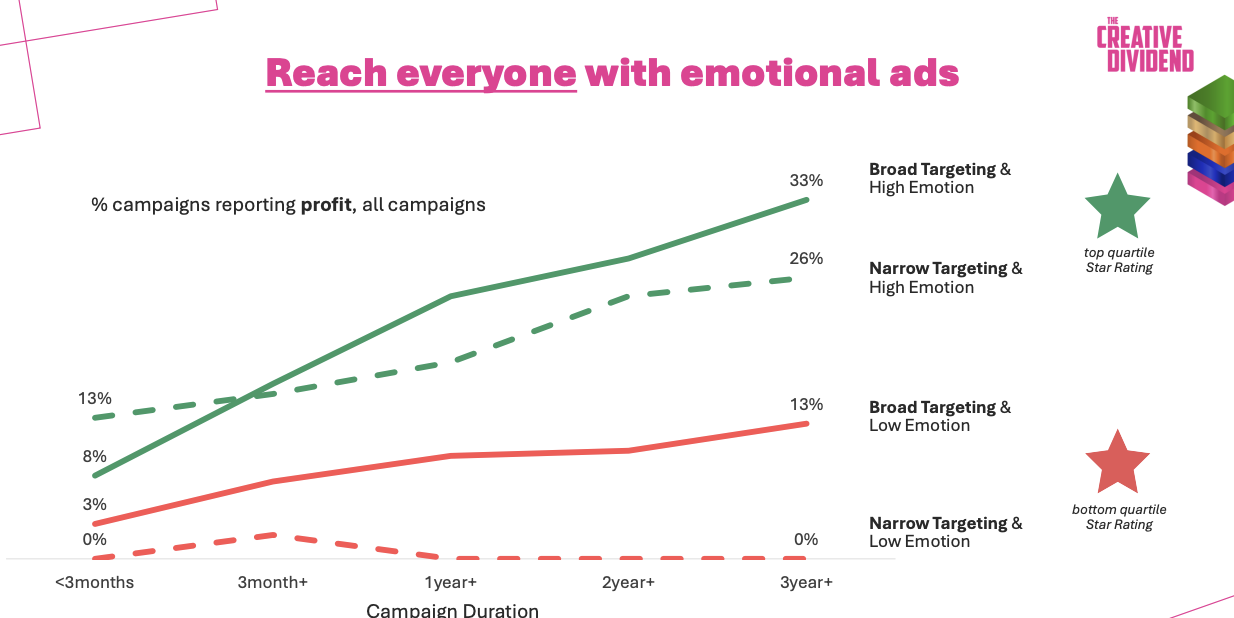
Similarly, just last year, System 1’s Creative Dividend paper showed that campaigns containing high levels of emotion reported 59% profit compared to those with low levels of emotion (only 13%). And amongst UK audiences, brands with high emotional advertising enjoyed 56% more business results (profit, penetration, revenue, reduced price sensitivity, loyalty, and share growth).
This also applies to B2B marketing. System 1 found that emotional B2B campaigns deliver 7x larger business effects than rational campaigns. And it stands to reason: B2B decision makers are human too!
I must note that there are other important factors such as distinctiveness and consistency in delivering marketing effectiveness (maybe that’s for another blog post). But the impact of appealing to emotions should not be understated given the disproportionately strong results of emotion-led campaigns compared to predominantly rational ones, especially when aiming for long-term growth.
This is not to say that rational messaging does not factor in our buying decisions. Feeling machines we may be, but we are not led entirely by our hearts.
Optimising for System 1 is about building memory structures and creating halo effects to make your brand the obvious choice. Functional messaging, supported by robust proof points and reasons to believe at (or close to) the point of sale (POS) appeals to the more rational processing of System 2. When torn between buying two strong brands, the decision comes down to which product most convincingly promises to solve our problem or offer the most desirable benefits.
But even in categories where functional performance is crucial and purchase prices are high, emotion can multiply the effects of rational messaging.
Binet and Field found that POS marketing that incorporated emotional priming boosted short-term behavioural responses, leading to both increased sales and - most interestingly - greater responsiveness towards rational messages. But when surveyed after the purchase, consumers rationalised their decisions in terms of the logical reasons to buy, instead of anything that played into their sense of self and made them feel a certain way.
Essentially, we humans are terrible at explaining our decisions. We are fundamentally emotional beings who use thinking to make sense of and act on what we already feel.

At RKH, we use thorough research to power effective campaigns that strike the ideal balance between long-term brand-building and short-term activation. Because we know what motivates audiences, we can develop campaigns tailored to our clients' needs, targeted at the right people, and designed to make a real impact.
We can work together to achieve real business results. Get in touch with us today.
Talk to us